
What Capacity Fiber Opening Machine Do You Need?
For manufacturers of pillows, plush toys, cushions, pet beds, sofa fillings, and home textile products, selecting a fiber opening machine with the right capacity is crucial.
While many customers recognize the need for a fiber opening machine, they are often unsure which capacity best suits their production requirements.
Some newcomers worry that small-scale equipment won't meet future output demands, while others are concerned that large-scale equipment will drive up investment costs, energy consumption, and factory floor space requirements.
So, exactly what capacity do you need?
What Does Fiber Opening Machine Capacity Mean?
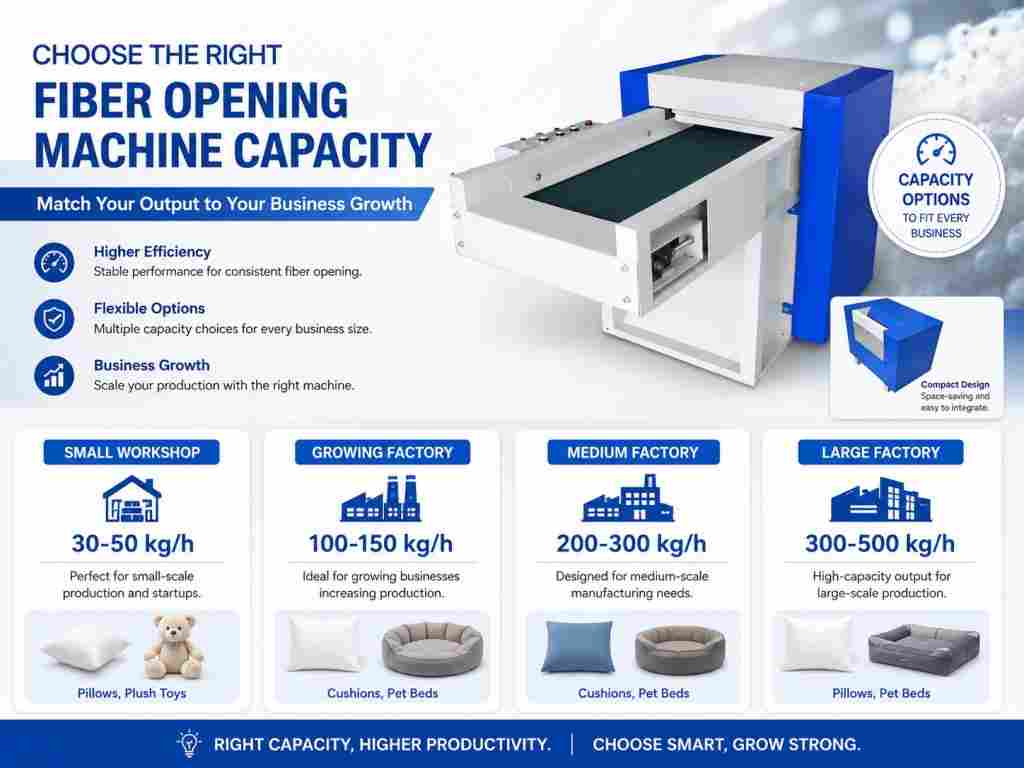
The capacity of an opening machine typically refers to the amount of fiber (in kilograms) the equipment can process per hour.
Common capacity ranges include:
30–50 kg/h
100–150 kg/h
200–300 kg/h
300–500 kg/h
The figures above are for reference only. Actual output may vary depending on factors such as fiber type, compression level, feeding method, moisture content, fiber quality, and operator experience.
When purchasing an opening machine, customers should not focus solely on maximum capacity; the most important factor is whether the equipment meets actual production needs.
Why Capacity Matching Is Important?Fiber Opening Machines are typically used in conjunction with filling processes.
If the opening machine's capacity is too low, the filling machine may not receive a sufficient supply of opened fiber, leading to downtime while waiting for material, reduced efficiency, and inconsistent output.
If the capacity is too high, the factory may face unnecessary investment costs, increased energy consumption, excessive use of floor space, and idle capacity.
When selecting equipment, bigger is not necessarily better; the ideal choice is equipment that matches your actual production needs.
1. Start With Your Product Type
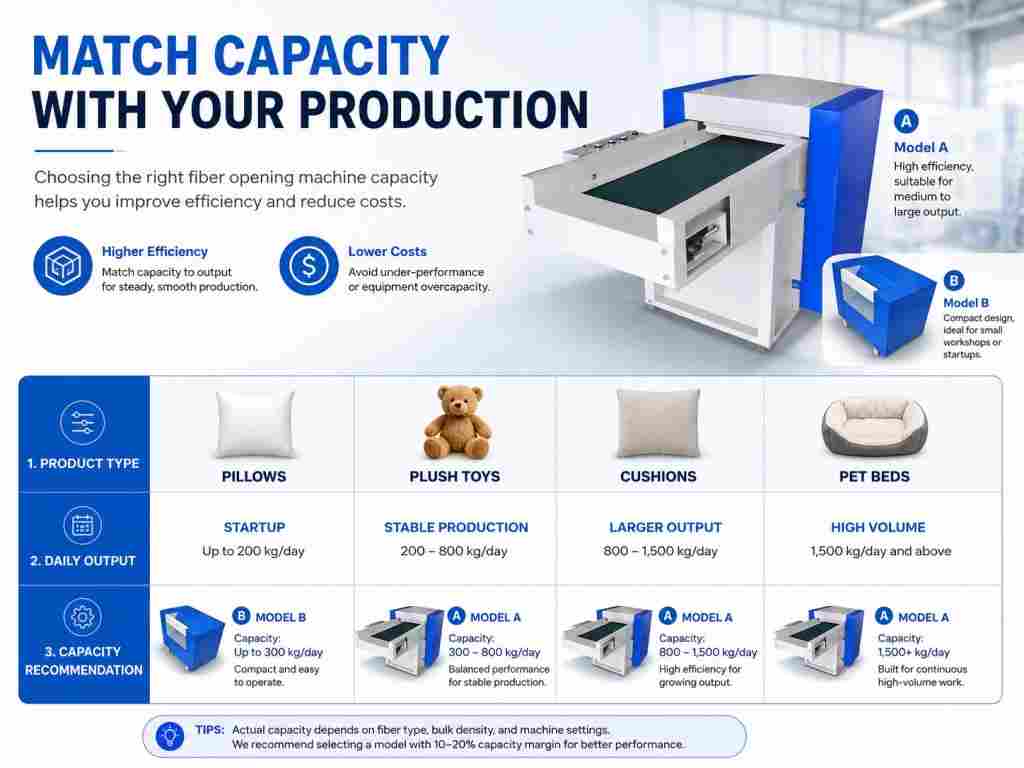
Different products have varying fiber consumption requirements.
For example, a single pillow typically consumes more fiber than a small plush toy, while pet beds and sofa cushions may require even larger amounts of fiber. Although the daily output of small plush toys can be high, each individual unit consumes relatively little fiber.
Therefore, production capacity should be calculated based on total fiber consumption rather than just the number of units produced.
A simple calculation method is as follows:
Daily fiber requirement = Daily production quantity × Fiber weight per unit
For example, if a factory produces 500 pillows daily and each pillow uses 0.8 kg of fiber, the daily fiber requirement is approximately 400 kg.
If the factory operates for 8 hours a day, the average fiber opening requirement is about 50 kg per hour.
In this scenario, equipment with a processing capacity of 30–50 kg per hour might be operating near its limit. If the client seeks more stable production or is considering future capacity expansion, choosing a model with higher processing capacity may be more appropriate.
2. Suggested Capacity for Different Factory Sizes
The following suggestions are for reference only. Final selection should be based on product dimensions, fiber material, operating hours, and production schedules.
Small-scale workshops: 30–50 kg/h
Opening machines with a capacity of 30–50 kg/h are suitable for small workshops and startup operations.
Suitable applications include:
Small pillow workshops
Small plush toy workshops
Home-based workshops
Low daily output requirements
Market trial/test-marketing phases
Such equipment typically involves lower investment costs and a small footprint. It is an ideal choice for startups looking to reduce manual fiber opening processes and improve fiber loft/softness.
Growing factories: 100–150 kg/h
Opening machines with a capacity of 100–150 kg/h are suitable for factories with relatively stable order volumes.
They support the production of:
Standard pillows
Plush toys
Cushions
Pet beds
For small-to-medium manufacturers, this is often a pragmatic choice that ensures production stability while maintaining reasonable investment costs.
Medium-sized factories: 200–300 kg/h
Opening machines with a capacity of 200–300 kg/h are suitable for factories with higher daily output.
Suitable applications include:
Medium-sized pillow factories
Pillow OEM suppliers
Plush toy manufacturers
Cushion and pet bed factories
At this scale, opening machines are typically paired with fiber blending boxes (mixing hoppers) to ensure continuous and stable fiber supply.
Large-scale factories: 300–500 kg/h or higher
Opening machines with a capacity of 300–500 kg/h are suitable for large-scale production.
They are typically used in complete production lines, such as:
Large-scale pillow production lines
Large-scale plush toy filling lines
Home textile filling plants
Sofa and cushion filling plants
Export-oriented manufacturing enterprises
High-capacity equipment typically requires more factory space, robust power supply, comprehensive material conveying systems, and strategic production line layout planning.
4. Consider Fiber Material Type
The difficulty of opening varies depending on the fiber material. Some fibers open up relatively easily, whereas other materials require more robust opening capabilities.
For instance, silicone-coated fibers typically flow well, while recycled fibers may contain higher levels of dust, impurities, and short fibers, or exhibit uneven fiber lengths; consequently, they often require greater opening force and more frequent cleaning.
Additionally, highly compressed fiber bales can result in lower actual output.
Before determining equipment capacity, customers should inform the supplier of the fiber materials they plan to use so that the supplier can recommend the most suitable equipment.
5. Consider Working Hours and Future Expansion
Machine capacity should also be calculated based on daily operating hours.
For example, two factories might both need to process 500 kg of fiber per day.
One factory operates for 10 hours a day.
The other operates for 5 hours a day.
To achieve the same output in less time, the second factory requires a higher hourly production capacity.
Customers should also consider future business expansion:
Will daily output increase in the future?
Will more filling equipment be added?
Will larger products be manufactured?
Will product lines such as pillows, cushions, or pet beds be added?
Will a complete production line be built in the future?
If the business is still in a trial phase, choosing a smaller machine can reduce initial risk.
If there are already stable orders and expansion plans, selecting equipment with slightly higher capacity may be more practical.
Common Mistakes When Choosing Capacity
Many customers make mistakes when purchasing fiber opening machines.
Common errors include:
Choosing the smallest machine model solely to save costs
Choosing the largest machine model without actual need
Overlooking the consumption requirements of downstream filling equipment
Ignoring the characteristics of the fiber materials
Failing to consider future capacity expansion needs
Failing to consider factory space and power supply conditions
Failing to calculate daily fiber consumption
The appropriate equipment should be selected based on actual production conditions, rather than focusing solely on price or machine size.
Selecting the right fiber opening machine capacity is crucial for the stable production of pillows, plush toys, cushions, pet beds, and home textile products.
For startups or small workshops, equipment with a capacity of 30–50 kg/hour is usually sufficient. For a factory in its growth phase, a capacity of 100–150 kg/h is often a practical choice.
Medium-sized factories might opt for equipment with a capacity of 200–300 kg/h to support more stable production.
Large-scale operations—especially when setting up fully automated filling lines—may require capacities of 300–500 kg/h or even higher.
The key is not simply choosing the machine with the highest capacity, but selecting the equipment best suited to your actual production needs.
FAQ: Fiber Opening Machine Capacity
What does the capacity of a fiber opening machine refer to?
It typically refers to the weight of fiber (in kilograms) the machine can open per hour.
Is actual capacity always equal to rated capacity?
Not necessarily. Actual capacity is influenced by factors such as fiber material, compression level, feeding speed, moisture content, and operator proficiency.
What capacity is suitable for a small workshop?
For small workshops producing pillows or plush toys, a capacity of 30–50 kg/h is a practical starting point.
What capacity is suitable for a growing factory?
For factories with stable daily output, a capacity of 100–150 kg/h is usually more appropriate.
Can INNOLD help select the right capacity?
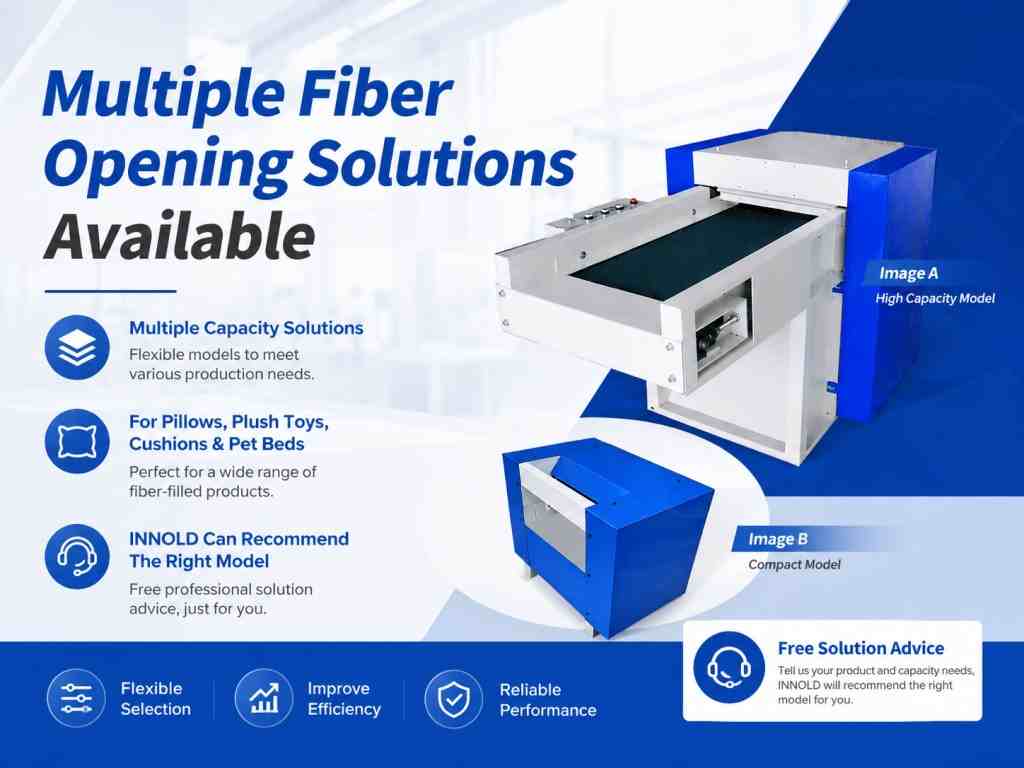
Yes. INNOLD can recommend the appropriate fiber opening machine capacity based on your product type, fiber material, daily output, operating hours, factory layout, and budget.
Free Production Solution Support from INNOLD
Different factories require different fiber opening and filling solutions.
INNOLD offers free professional advice on fiber opening machine capacity and production line configuration, tailored to your product type, fiber material, daily output, filling machine model, factory size, and investment budget.
Whether you are starting a small workshop for pillows or plush toys, or planning a complete fiber opening and filling production line, INNOLD can help you select the right equipment to ensure stable and efficient production.
Post time:2026-08-19
