
Why Does Fiber Become Clumpy During Filling?
Fiber clumping is a common issue during the production of pillows, plush toys, cushions, and pet beds. Many manufacturers encounter problems where fibers do not flow smoothly during the filling process, or the finished product has an uneven feel—with some areas feeling hard while others are overly soft.
Fiber clumping directly impacts filling quality, production efficiency, and customer satisfaction.
So, why do fibers clump during the filling process, and how can this problem be resolved?
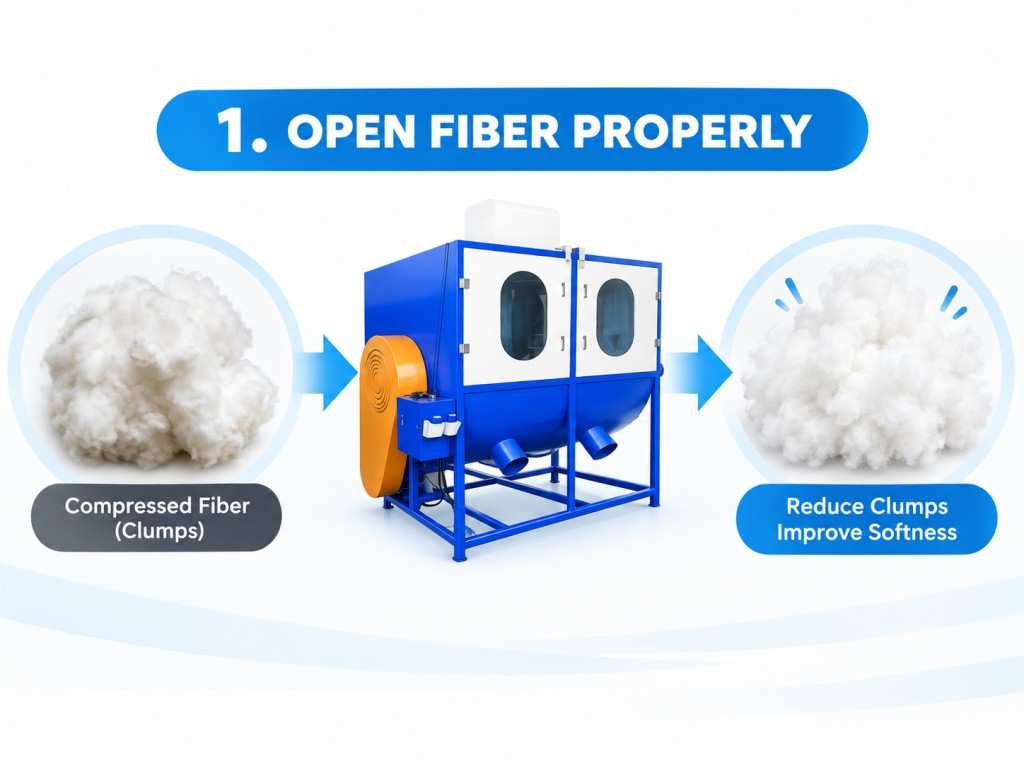
1. Fiber Is Not Opened Properly
Most polyester fibers, PP cotton, recycled fibers, and hollow fibers are compressed into bales for transport and storage.
If the fibers are not sufficiently opened before filling, large clumps may remain. These clumps can clog filling pipes, slow down production, and result in uneven filling within the product.
A Fiber Opening Machine can be used to loosen the compressed fibers prior to filling. Once opened, the fibers become softer and fluffier, making them easier to convey through the filling equipment.
2. Fiber Quality Is Not Stable
Fiber quality significantly impacts the filling process.
If the fibers contain excessive dust, short fibers, or impurities, or if the fiber length is uneven, they are more prone to tangling during conveying and filling.
This issue is particularly common when using low-grade recycled fibers or filling materials of poor processing quality.
To ensure production stability, manufacturers should select cleaner fiber materials and utilize appropriate fiber-opening equipment.
3. Air Pressure Is Too Low Or Unstable
Most fiber-filling machines use airflow to transport fibers into pillows, plush toys, cushions, or pet beds.
If the air pressure is too low, the fibers may not flow smoothly through the piping, causing them to accumulate and gradually clump together inside the pipes or nozzles.
Inconsistent airflow can also lead to uneven filling speeds.
Selecting the right air compressor is crucial for maintaining a stable filling process. The compressor's specifications should match the filling machine model, the number of nozzles, the fiber material, and the production capacity.
4. Filling Nozzle Or Pipe Is Not Suitable
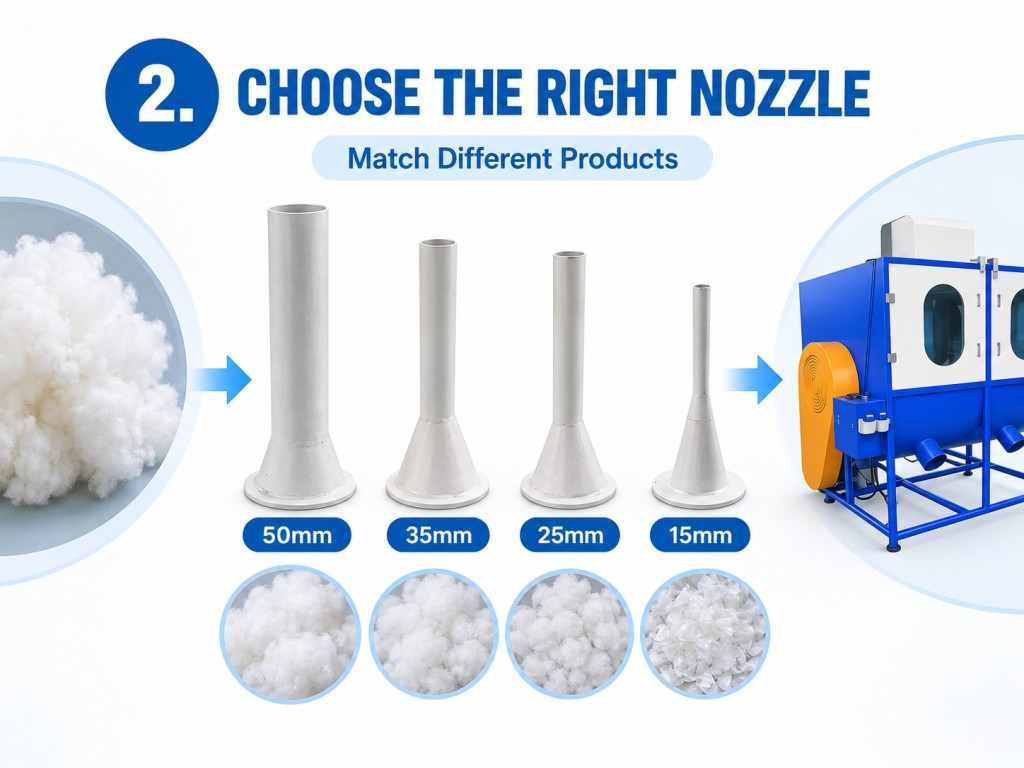
The size of the filling nozzle also affects fiber flow.
If the nozzle is too small relative to the fiber material or the size of the product, fibers may accumulate at the outlet and cause a blockage. Fibers can also build up inside the system if the piping is excessively long or narrow, or if it is not cleaned regularly.
In the production of plush toys, different toy sizes may require nozzles of different specifications. Using a filling machine equipped with interchangeable nozzles helps increase flexibility and reduce the risk of clogging.
5. Fiber Moisture Or Storage Conditions Are Poor
The fiber should be stored in a dry, clean environment.
If the fiber becomes damp, it may gain weight, become sticky, and be difficult to fluff up; damp fiber is also more prone to clumping during the filling process.
Facilities should ensure the fiber material is kept away from moisture and dust and avoid direct contact with the floor. Proper storage helps maintain the fiber's loft, thereby improving the filling performance.
6. Production Line Is Not Properly Matched
Improper coordination between the various stages of the production line can also lead to fiber clumping.
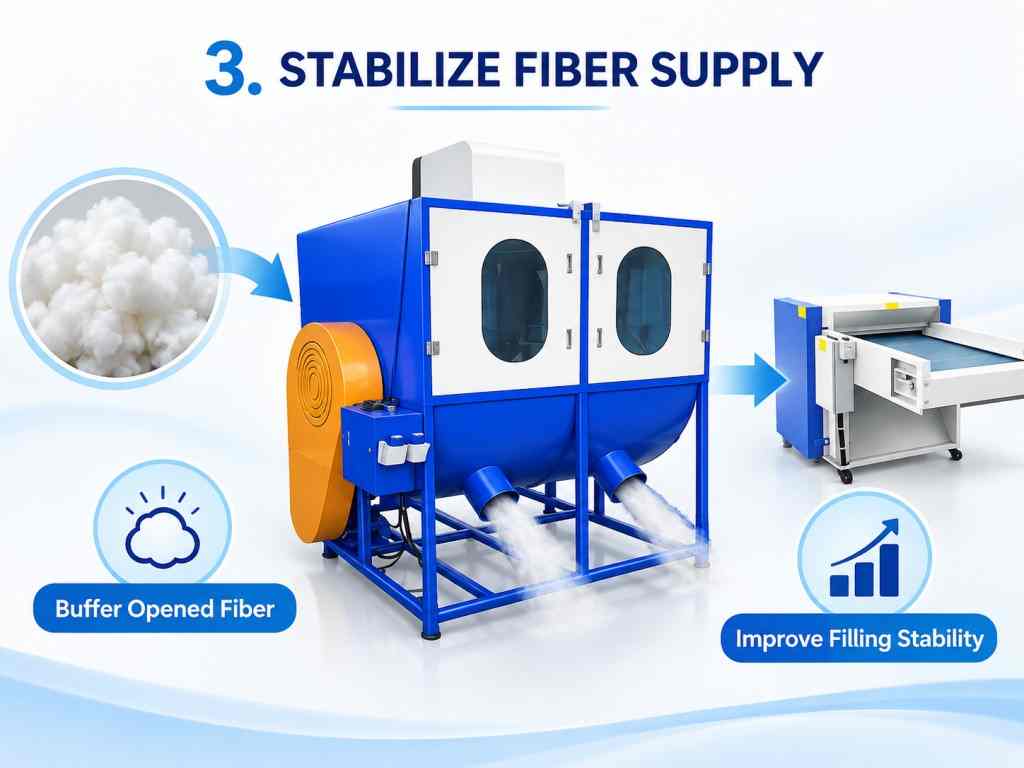
For instance, if the output from the opening machine is inconsistent, or if the fiber consumption rate of the filling machine exceeds the supply rate from the opening machine, the production process may be interrupted.
Installing a fiber mixing bin helps address this issue. It acts as a storage and buffer unit for the opened fibers, ensuring a more continuous and stable supply.
For medium-to-large factories, adopting an integrated production line that encompasses feeding, opening, mixing, and filling processes can significantly enhance production stability.
How To Reduce Fiber Clumping?
To minimize fiber clumping during the filling process, manufacturers should focus on the following areas:
Thoroughly opening and loosening compressed fibers prior to filling
Using clean, high-performance, and stable fiber materials
Maintaining stable air pressure
Selecting the appropriate filling nozzle size
Regularly cleaning pipelines and nozzles
Storing fibers in a dry environment
Properly matching the fiber opening machine, mixing chamber, and filling equipment
The goal is to ensure that the fibers remain fluffy, uniform, and easy to transport before entering the product.
In the production of pillows and plush toys, fiber clumping is a primary cause of uneven filling, reduced efficiency, and equipment blockages.
This issue can generally be effectively mitigated by employing suitable fiber opening processes, stable airflow, appropriate nozzle sizes, clean raw materials, and a well-matched production line.
Whether manufacturing pillows, plush toys, cushions, or pet beds, smooth fiber transport is crucial for ensuring consistent product quality.
INNOLD offers free professional advice on fiber opening and filling production solutions tailored to your raw materials, product types, daily output requirements, and budget.
FAQ: Fiber Clumping During Filling
Why do fibers clump during the filling process?
Fiber clumping can be caused by factors such as insufficient fiber opening, inconsistent fiber quality, low air pressure, undersized nozzles, or poor fiber storage conditions.
Can using a fiber opening machine reduce fiber clumping?
Yes. An opening machine loosens compressed fibers before filling, making them softer, fluffier, and more uniform.
Are recycled fibers more prone to clumping?
Sometimes, yes. Recycled fibers may contain more dust or short fibers and often have uneven fiber lengths; consequently, they usually require more thorough opening and regular equipment cleaning.
Can low air pressure cause fiber blockages?
Yes. If air pressure is too low or unstable, fibers may not flow smoothly through the pipes, leading to clumping within the system.
Can INNOLD help resolve fiber clumping issues?
Yes. INNOLD can recommend suitable opening machines, filling machines, air compressor configurations, and production line layouts tailored to your specific production needs.
Post time:2026-09-19
