
How to Fill Sofa Cushions with Polyester Fiber Efficiently?
Polyester fiber is widely used in sofa cushions, decorative pillows, back cushions, pet beds, and other upholstered furniture products.
For manufacturers, efficient cushion filling involves much more than simply stuffing fiber into a cover. The primary objectives are to achieve:
Rapid filling speeds
Uniform fiber distribution
Well-filled corners
Consistent weight
Excellent softness and resilience
Lower labor costs
If the fiber is not properly pre-treated or the filling process is handled incorrectly, the finished cushions may appear flat or uneven, develop clumps, or even lack consistency from one piece to another.
So, how can manufacturers use polyester fiber more efficiently to fill sofa cushions?
1. Open The Fiber
During transport and storage, polyester fibers are typically compressed into bales.
If these compressed fibers are used directly to fill cushions, they may clump together, resulting in uneven density.
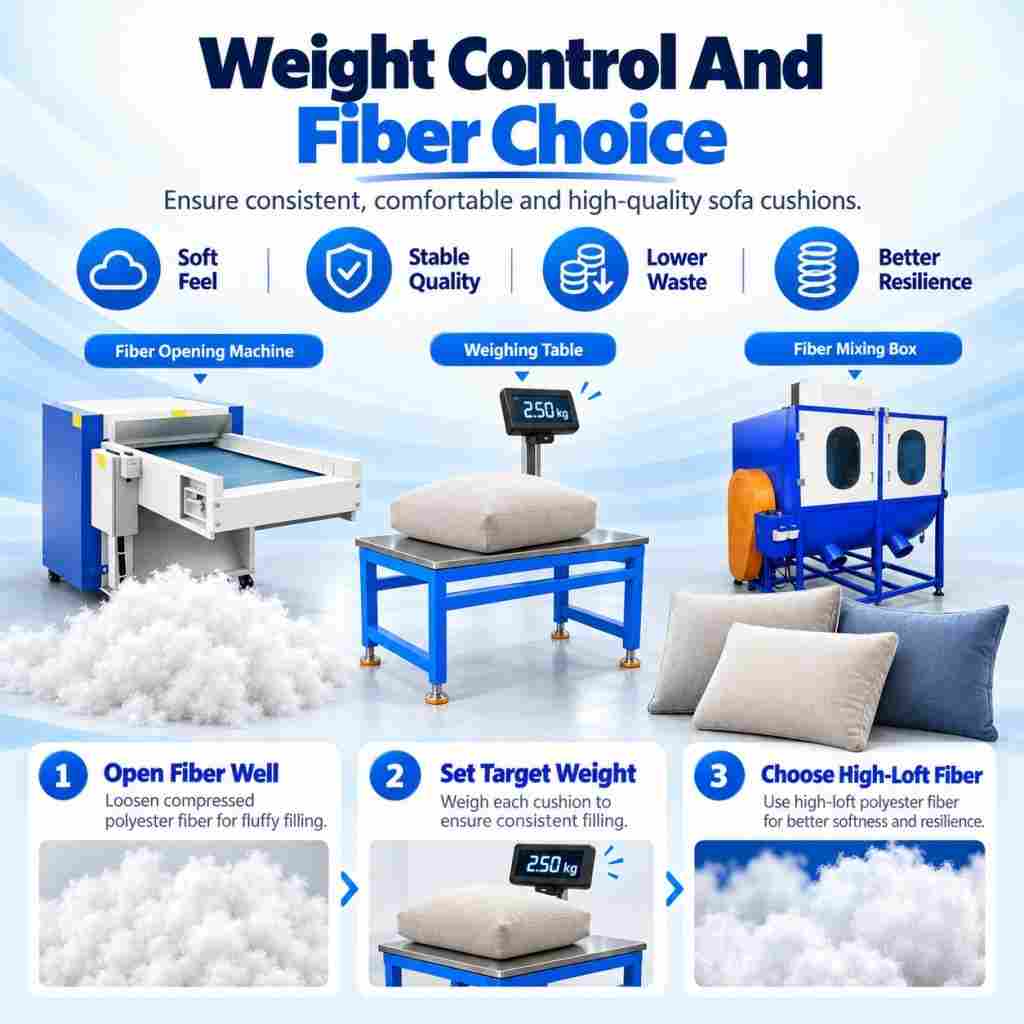
A Fiber Opening Machine can be used to loosen the compressed fibers prior to the filling process.
Once thoroughly opened, the fibers become softer, loftier, and more uniform—making them easier to transport and more effective at filling into corners and crevices.
Conversely, using compressed, unopened fibers for filling can lead to the formation of large clumps inside the cushion, causing an irregular shape in the finished product and reducing filling efficiency.
2. Stable Supply Of Fibers
In a continuous production process, the Cushion Stuffing Machine requires a stable supply of opened fiber raw material.
A Fiber Mixing Machine can be installed between the Cotton Opening Machine and the Fiber Filling Machine.
This unit serves to store and buffer the opened fibers, thereby reducing operational interruptions between the opening and filling stages.
3. Correct Filling Method
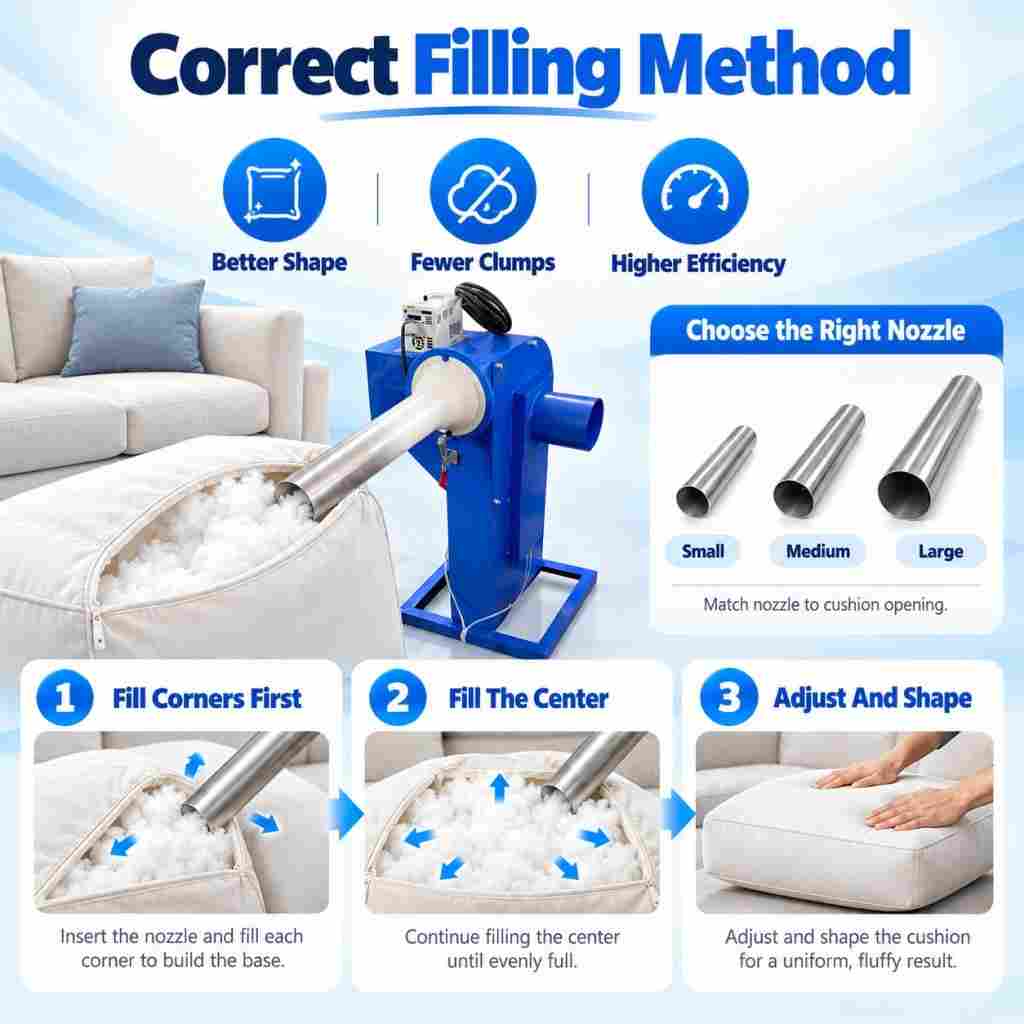
A common issue during the production of sofa cushions is that the center may appear full, while the corners and edges look hollow or underfilled.
A practical solution is to direct the filling nozzle toward the corners and edges first, and then fill the central area.
Operators should shift the cushion periodically during the filling process to ensure the fibers are distributed evenly.
The goal of the filling process is to prevent issues such as hollow corners, fiber clumping, overfilling in the center, and unevenness between the left and right sides.
Proper technique can significantly improve the final shape and appearance of the cushion.
4. Use A Suitable Fiber Filling Machine
For very small-scale production, manual filling may be feasible; however, as daily output increases, this method becomes inefficient.
Fiber Stuffing Machines use airflow to transport opened polyester fibers into cushion covers.
Compared to manual filling, this approach offers several advantages: faster filling speeds, reduced worker fatigue, more uniform filling, less manual handling of fibers, and increased daily output.
5. Choose The Correct Filling Machine Nozzle
Cushions and their filling openings of various sizes require corresponding nozzle sizes.
If a nozzle is too small, the Polyester Fiber Cushion Filling Machine filling speed may decrease, and the risk of clogging may increase.
If a nozzle is too large, it becomes difficult to control the flow of the filling material when inserting it into smaller openings.
For larger sofa cushions, using a larger nozzle generally increases Sofa Cushion Filling Machine filling speed, whereas smaller cushions may require a smaller nozzle to allow for more precise control.
The use of interchangeable nozzles enables a single filling machine to handle products of different sizes with greater flexibility.
6. Control Filling Weight
Maintaining consistent fill weight is crucial for standardized production.
If there is too little filling, the cushion may appear flat or deflated.
If there is too much filling, the cushion may become overly firm, and material costs will also increase.
A target fill weight should be established for each cushion size, based on the following factors:
Cushion dimensions
Type of filling material
Desired firmness
Customer requirements
Implementing a weighing system helps factories achieve more consistent filling results.
7. Choose Suitable Polyester Fiber
Not all polyester fibers perform the same.
Factors such as fiber length, fineness, crimp, silicone treatment, and resilience all influence how a fiber performs as a filling material.
Compared to fibers with higher density or poor loft, fibers with excellent loft may require a smaller quantity to achieve the same level of fullness.
Therefore, when evaluating materials, manufacturers should consider both of the following metrics:
Fiber weight + volume of the finished cushion
Rather than simply comparing the unit price of the fibers.
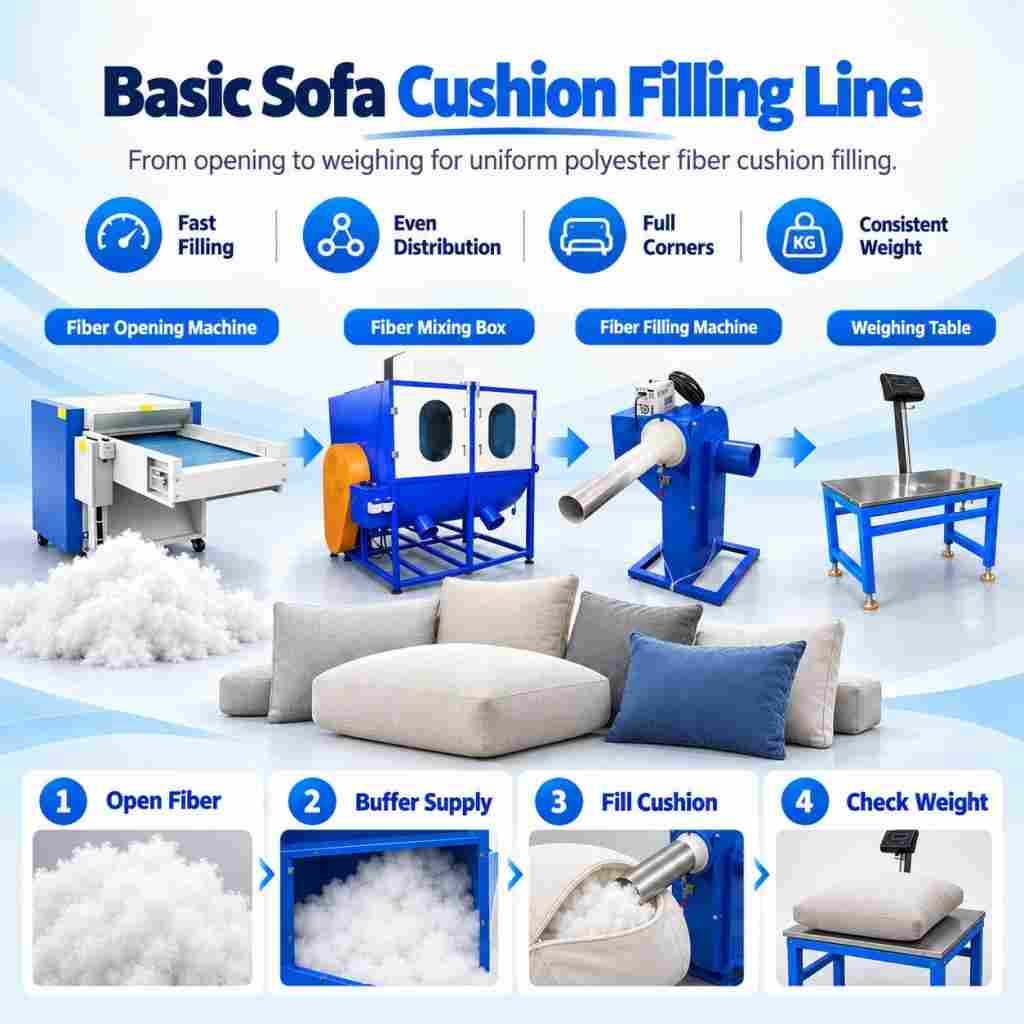
Recommended Production Line Processes
A practical production process for filling sofa cushions is as follows:
Compressed fiber → Opening → Blending → Filling → Weight verification → Shaping → Sewing → Inspection
For small-scale workshops, a fiber opening machine and a filling machine are sufficient to meet operational needs.
For medium-to-large-scale factories, the addition of a blending chamber and a weighing system helps improve production consistency and reduces the need for manual labor.
Efficient sofa cushion filling depends on more than just speed.
Factors such as thorough fiber opening, a stable supply of fiber, the selection of appropriate nozzles, precise filling weight, and the skill of the operators all influence the quality of the final product.
For manufacturers producing polyester-filled sofa cushions, a well-configured fiber opening and filling system helps enhance:
Production efficiency, cushion aesthetics, filling uniformity, and overall labor productivity.
INNOLD can recommend the ideal fiber opening and filling solution tailored to your specific cushion dimensions, type of polyester fiber, daily production targets, available factory space, and budget.
Contact Us
Email: info@syinnold.com
WhatsApp: +86 180 4005 4857
FAQ:
Can polyester fiber be used for sofa cushions?
Yes. Polyester fiber is widely used for sofa back cushions, decorative cushions, throw pillows, and other soft-filled products.
Do I need a fiber opening machine?
If you use compressed polyester fiber, a fiber opening machine is recommended because it improves fiber softness, loft, and filling consistency.
Why are cushion corners sometimes not full?
Common reasons include poor filling technique, insufficient fiber opening, unsuitable nozzle size, or low filling weight.
Can a fiber filling machine improve production efficiency?
Yes. It can reduce manual filling work, increase filling speed, and improve product consistency.
Can one filling machine handle different cushion sizes?
Yes. A machine with interchangeable nozzles can handle different cushion sizes and filling openings more flexibly.
Can INNOLD recommend a cushion filling solution?
Yes. INNOLD can recommend suitable equipment according to your cushion dimensions, fiber material, filling weight, production capacity, and budget.

Post time:2026-10-24
